Loading Piedocx...
+91 6307503700 +91 7068289977 info@piedocx.com
Intro Price: Get UpSkill For Big Sale 40% OFF Verify Certificate
Piedocx Technologies

Follow Us

Quick Enquiry
We'll get back to you in 24hrs
△
▸
+
▲

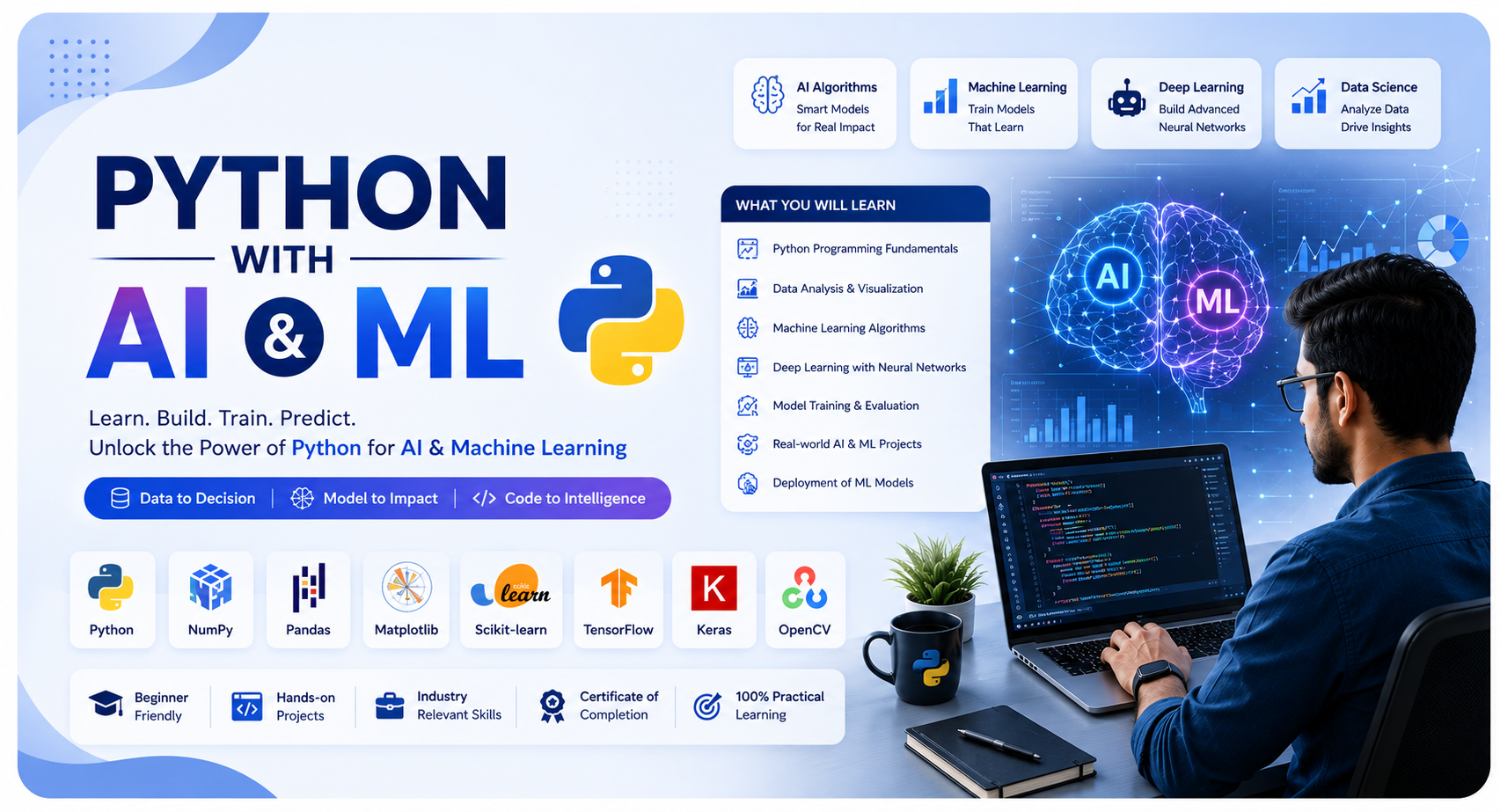
Python With AI & ML

Python With AI & ML Beginner

Python With AI & ML

Mr. Savan Rai
Mr. Savan Rai
Founder & CEO (Python With Gen AI)
★★★★★ (25)

Looking for the best Python with AI & ML course in Lucknow? This 8-month (32-week) industry-oriented training program takes you from complete beginner to a job-ready AI/ML Engineer — no prior coding experience required.

This Machine Learning and Artificial Intelligence course covers Python Programming, Data Structures & Algorithms (DSA), SQL, Statistics, Machine Learning, Deep Learning, Computer Vision, Natural Language Processing (NLP), and Generative AI (LLMs, RAG, AI Agents, LangChain). Every concept is taught with a math-first approach — built from scratch in Python before moving to industry-standard tools like Scikit-learn, TensorFlow, PyTorch, and LangChain.

Key highlights of this AI & ML training program:
- 8 real-world, portfolio-ready projects (one every month)
- Weekly interview preparation built into the curriculum
- Hands-on training in Python, Machine Learning, Deep Learning & Generative AI
- Dedicated placement assistance — resume building, mock interviews, GitHub portfolio support
- Beginner-friendly, Hindi/English (Hinglish) instruction
- Ideal for final-year students, recent graduates, and career switchers into Data Science and AI

Join Piedocx Technologies' Python with AI & ML course and become a certified AI/ML professional with real project experience and placement support.

What You'll Learn

Introduction to Python
Python Control Flow, Functions & OOP
File Handling, Exception Handling & Modules
Data Structures (Arrays, Linked Lists, Stacks, Queues, Hashing)
Searching, Sorting & Complexity Analysis
Recursion, Backtracking & Dynamic Programming
Trees, Graphs & Advanced Data Structures
NumPy & Advanced Pandas
SQL for Data Science
Statistics & Probability for Machine Learning
Data Visualization & Storytelling
Linear Regression & Regularization
Classification Algorithms (Logistic Regression, KNN, SVM, Decision Trees)
Ensemble Learning (Random Forest, XGBoost, LightGBM)
Feature Engineering & Unsupervised Learning
Model Explainability (SHAP, LIME)
Time Series Forecasting
Recommendation Systems & A/B Testing
ML Pipelines & Experiment Tracking (MLflow)
Neural Networks & Deep Learning Foundations
Convolutional Neural Networks (Computer Vision)
Recurrent Neural Networks & NLP
Transformer Architecture (BERT, GPT)
Generative AI & Large Language Models
Prompt Engineering
LangChain & Vector Databases
Retrieval-Augmented Generation (RAG)
AI Agents & Multi-Agent Systems
Model Deployment (Flask, FastAPI, Docker)
MLOps & Cloud Basics (AWS/Azure)
System Design for AI/ML
Capstone Project & Placement Preparation

Course Curriculum

MONTH 1 — PYTHON PROGRAMMING MASTERY
Week 1: Python Fundamentals & Environment +
Python installation, Anaconda, Jupyter, VS Code professional setup
• Data types, variables, Python memory model (mutable vs immutable)
• Operators, expressions, type conversion
• Advanced string handling — formatting, slicing, regex introduction
Interview Prep Focus: Output-prediction questions, Python basics MCQ rounds
Week 2: Control Flow, Functions & Functional Programming +
• Conditionals, nested loops, loop optimization techniques
• Functions — default/keyword args, *args/**kwargs, variable scope, closures
• Lambda, map/filter/reduce, list/dict/set comprehensions
• Decorators and generators (yield) with real use cases
Interview Prep Focus: Comprehension-based coding challenges, closures/decorators questions
Week 3: OOP — Deep Dive +
• Classes, objects, constructors, instance vs class variables
• Encapsulation, Inheritance (single/multiple/multilevel), Polymorphism, Abstraction
• Magic/dunder methods, operator overloading
• Intro to design patterns — Singleton, Factory
Interview Prep Focus: OOP design questions, 'design a class for X' style rounds
Week 4: Exceptions, File I/O, Modules & Testing +
• Try/except/finally, custom exception classes
• File handling — text, CSV, JSON, pathlib
• Modules, packages, pip, virtual environments (venv/conda)
• Unit testing basics with pytest
Interview Prep Focus: Debugging & error-handling scenario questions
Month-End Project: A tested, unit-tested CLI/OOP-based system (e.g., Inventory or Booking Manager) with
proper exception handling — first GitHub portfolio piece.
MONTH 2 — DSA & ADVANCED PROBLEM SOLVING
Week 5: Core Data Structures +
• Arrays/Strings — internal implementation & classic algorithms
• Stack, Queue, Deque (array-based & linked-list-based)
• Linked Lists — singly, doubly, circular (full implementation)
• Hashing — HashMap/HashSet internals, collision handling
Interview Prep Focus: Top 15 Array/String problems (two-pointer, sliding window patterns)
Week 6: Searching, Sorting & Complexity Analysis +
• Time/Space complexity — Big-O, Big-Theta, Big-Omega
• Linear/Binary Search and all variations
• Bubble, Selection, Insertion, Merge, Quick, Heap Sort
• Choosing the right algorithm for interview scenarios
Interview Prep Focus: Sorting/searching pattern-recognition problems
Week 7: Recursion, Backtracking & Dynamic Programming +
• Recursion tree visualization, recursion vs iteration tradeoffs
• Backtracking — N-Queens, Sudoku Solver, Permutations/Subsets
• DP — memoization vs tabulation, 1D & 2D DP
• Classic DP: Knapsack, LCS, LIS, Coin Change, Matrix Chain Multiplication
Interview Prep Focus: DP pattern-recognition framework — 'how to identify a DP problem'
Week 8: Trees, Graphs & Advanced Structures +
• Binary Tree, BST, Heap/Priority Queue, AVL Tree (intro)
• Tree traversals (recursive & iterative) and tree-based problems
• Graph representation, BFS/DFS, Topological Sort
• Dijkstra's Algorithm, Union-Find (Disjoint Set) basics
Interview Prep Focus: Graph/Tree problems — company-wise curated interview sheet.
Month-End Project: 50+ DSA problems solved and documented on GitHub as a structured 'Problem Tracker'
with approach notes — the single most-checked artifact by recruiters.
MONTH 3 — DATA ANALYSIS, SQL & STATISTICAL FOUNDATIONS
Week 9: NumPy & Advanced Pandas +
Tools/Tech: NumPy, Pandas
• NumPy internals, broadcasting, vectorization, performance tricks
• Advanced Pandas — multi-indexing, pivot tables, merge/join strategies
• Time-series handling basics with Pandas
• Optimizing Pandas for large datasets (chunking, dtypes)
Interview Prep Focus: Live Pandas coding round — data manipulation under time pressure
Week 10: SQL for Data Science — Deep +
Tools/Tech: MySQL/PostgreSQL, SQLAlchemy
• DDL/DML, complex joins, correlated subqueries, CTEs
• Window functions, ranking functions (ROW_NUMBER, RANK, LAG/LEAD)
• Query optimization & indexing fundamentals
• Connecting Python↔SQL, ORM basics (SQLAlchemy)
Interview Prep Focus: SQL interview problem sets — window functions & join-heavy queries
Week 11: Statistics & Probability — Deep +
• Descriptive statistics, probability distributions (Normal, Binomial, Poisson)
• Central Limit Theorem, Confidence Intervals
• Hypothesis testing — Z-test, T-test, Chi-square, ANOVA
• Correlation, covariance, and A/B testing fundamentals
Interview Prep Focus: Statistics case-study questions — the most-feared ML interview segment
Week 12: Data Visualization, Storytelling & Git Mastery +
Tools/Tech: Matplotlib, Seaborn, Plotly, Git/GitHub
• Advanced dashboards with Matplotlib/Seaborn/Plotly
• Business storytelling — choosing the right chart for the audience
• Git branching strategy, rebasing, conflict resolution
• Building a recruiter-ready GitHub profile
Month-End Project: Full statistical analysis + interactive dashboard on a real dataset, backed by a SQL
database — published with a professional README.
MONTH 4 — CORE MACHINE LEARNING
Week 13: ML Foundations & Linear Models +
Tools/Tech: Scikit-learn
• ML lifecycle, bias-variance tradeoff, ML problem framing
• Linear Regression — full math derivation, gradient descent from scratch (NumPy)
• Multiple/Polynomial Regression, Regularization (Ridge/Lasso/ElasticNet)
• Regression assumptions & diagnostic plots
Interview Prep Focus: ML theory + math derivation questions (a top filter in real interviews)
Week 14: Classification Algorithms — Deep +
• Logistic Regression — math + from-scratch implementation
• KNN, Naive Bayes, Decision Trees (Gini/Entropy, pruning)
• SVM — kernel trick and margin intuition
• Evaluation metrics deep-dive — ROC-AUC, PR curve, threshold tuning
Interview Prep Focus: 'Which algorithm and why' — comparative reasoning questions
Week 15: Ensemble Learning & Model Optimization +
Tools/Tech: XGBoost, LightGBM, CatBoost, Optuna
• Bagging, Random Forest, Boosting (AdaBoost, Gradient Boosting)
• XGBoost, LightGBM, CatBoost — industry-standard boosters
• Stacking & blending, hyperparameter tuning (Grid/Random/Bayesian via Optuna)
• Cross-validation strategies & model selection frameworks
Interview Prep Focus: Ensemble methods deep-dive & Kaggle-style reasoning questions
Week 16: Feature Engineering & Unsupervised Learning +
• Feature scaling, encoding, feature selection techniques
• Handling imbalanced data — SMOTE, class weighting
• Clustering — K-Means, DBSCAN, Hierarchical; PCA & t-SNE
• Anomaly detection fundamentals
Month-End Project: Kaggle-style competition project — full pipeline from raw data to leaderboard-style
model comparison, documented like a real data science deliverable.
MONTH 5 — ADVANCED ML, EXPLAINABILITY & MLOPS FOUNDATIONS
Week 17: Model Explainability & Interpretability +
Tools/Tech: SHAP, LIME
• SHAP & LIME — explaining black-box model predictions
• Feature importance analysis techniques
• Model fairness & bias detection fundamentals
• Explainability in regulated industries (finance/healthcare case studies)
Interview Prep Focus: 'Explain your model to a non-technical stakeholder' rounds
Week 18: Time Series Forecasting +
Tools/Tech: statsmodels, Prophet
• Time series components, stationarity, ADF test
• ARIMA/SARIMA modeling
• Facebook Prophet for business forecasting
• Feature-based ML forecasting approaches
Week 19: Recommendation Systems & A/B Testing +
• Collaborative filtering & content-based filtering
• Matrix factorization basics
• A/B test design & statistical significance testing
• Building a real-world recommendation engine mini-project
Interview Prep Focus: Product-sense + statistics hybrid questions (common at product companies)
Week 20: ML Pipelines & Experiment Tracking +
Tools/Tech: MLflow / Weights & Biases
• Scikit-learn Pipelines & ColumnTransformer for clean workflows
• Experiment tracking with MLflow / Weights & Biases
• Model versioning and reproducibility practices
• Preparing models for handoff to engineering teams
Month-End Project: End-to-end, reproducible ML pipeline with tracked experiments — the kind of workflow
used inside real data science teams
MONTH 6 — DEEP LEARNING, COMPUTER VISION & NLP
Week 21: Neural Network Foundations — Math Deep Dive +
Tools/Tech: NumPy, Keras/PyTorch
• Perceptron, forward & backward propagation — full math, coded from scratch in NumPy
• Activation functions, loss functions, optimizers (SGD, Adam, RMSProp)
• Weight initialization strategies, batch normalization
• Rebuilding the same ANN using Keras and PyTorch
Interview Prep Focus: 'Derive backpropagation' and optimizer-comparison questions
Week 22: Computer Vision with CNNs +
• Convolution, pooling operations, CNN architecture design
• Landmark architectures overview — LeNet, VGG, ResNet
• Image augmentation & Transfer Learning
• Object detection fundamentals (YOLO — conceptual overview)
Week 23: NLP & Sequence Models +
• Text preprocessing, TF-IDF, Word2Vec/GloVe embeddings
• RNN, LSTM, GRU for sequence modeling
• Attention mechanism — deep, worked-through explanation
• NLP project: text classification / sentiment analysis
Week 24: Transformer Architecture — Deep +
• Full Transformer breakdown — encoder-decoder, self-attention, multi-head attention
• BERT vs GPT family — architectural comparison
• Fine-tuning pre-trained models with HuggingFace
• Choosing the right pre-trained model for a task
Interview Prep Focus: 'Explain attention/transformers' — now a standard AI-role interview question
Month-End Project: Deep Learning capstone (Computer Vision OR NLP) trained, evaluated, and deployed as
a live demo — a strong portfolio centerpiece.
MONTH 7 — GENERATIVE AI, LLMS & AGENTIC SYSTEMS 2026's
Week 25: LLM Foundations & Advanced Prompt Engineering +
• Tokenization, embeddings, context window — simulated from first principles
• Advanced prompting — Chain-of-Thought, ReAct, self-consistency, prompt chaining
• Working with LLM APIs — OpenAI, Anthropic, Gemini, open-source (HuggingFace)
• Cost optimization & rate-limit handling in production
Week 26: LangChain, LlamaIndex & Vector Database +
Tools/Tech: LangChain, Pinecone/ChromaDB/FAISS
• LangChain deep dive — chains, agents, memory, tools
• Vector databases compared — Pinecone, ChromaDB, FAISS, Weaviate
• Embedding model selection criteria
• Building a semantic search system from scratch
Week 27: RAG Systems — Advanced +
• RAG architecture deep dive, chunking strategy design
• Hybrid search — combining keyword + semantic retrieval
• RAG evaluation — faithfulness, relevance, groundedness metrics
• Multi-document RAG system with source citations
Interview Prep Focus: System-design style questions: 'design a RAG system for X'
Week 28: AI Agents & Multi-Agent Systems +
Tools/Tech: LangGraph / CrewAI
• Agentic AI concepts — tool-calling, function calling
• Multi-agent orchestration (LangGraph/CrewAI overview)
• Building autonomous, task-solving agents
• Responsible AI — limitations, hallucination control, guardrails
Month-End Project: Production-grade agentic AI application — the most in-demand, resume-differentiating
project in the current market.
MONTH 8 — MLOPS, CLOUD DEPLOYMENT, SYSTEM DESIGN & PLACEMENT SPRINT
Week 29: Deployment & Containerization +
Tools/Tech: Flask, FastAPI, Docker, Streamlit/Gradio
• Production-grade APIs with Flask/FastAPI
• Docker — containerizing ML/GenAI applications
• Streamlit/Gradio for interactive demos
• CI/CD basics with GitHub Actions
Week 30: Cloud & MLOps +
Tools/Tech: AWS/Azure/GCP basics, Kubernetes (intro)
• Cloud fundamentals for ML — S3/EC2/SageMaker or Azure ML overview
• Kubernetes basics for scaling ML services
• Model monitoring & drift detection
• End-to-end MLOps architecture walkthrough
Week 31: System Design for AI/ML + Capstone Build +
• ML system design interview framework
• Case studies — designing a recommendation system, search engine, chatbot at scale
• Full capstone project development (student's own choice, full-stack AI app)
• Peer code review & professional documentation
Interview Prep Focus: ML System Design mock rounds — now standard at product companies
Week 32: Placement Sprint +
• Resume, LinkedIn & GitHub portfolio finalization
• Mock interviews — technical, HR, and system design rounds
• Curated interview question bank (500+ Q&A across DSA/ML/DL/GenAI)
• Salary negotiation basics & job application strategy
Month-End Project: Final Capstone — a fully deployed, end-to-end AI system (ML/DL/GenAI) presented
with a placement-ready resume and portfolio.

Requirement For This Course

Computer / Mobile
Internet Connection
Paper / Pencil

Course Includes

280 Lessons
550
Beginner
Hindi/English
25+ Enrolled
Certificate on Completion
Your Journey With Us

From enrollment to a career you'll enjoy

Six simple steps — that's the entire path from signing up to building a career you're genuinely excited about, with Piedocx supporting you at every stage.

Day 1Month 1–8Month 7–8 Month 7–8Month 7–8Ongoing
Start
Step 01

Enroll

Register for your course and get instant access to your LMS, mentors and community.

Day 1
Step 02

Complete 8 Months

Work through the full curriculum — 8 real projects, weekly interview prep, one month at a time.

Month 1–8
Step 03

Join Interview

Our placement cell lines you up with mock rounds first, then real interviews with hiring partners.

Month 7–8
Step 04

Boost Your Experience

Close skill gaps with targeted practice, GitHub & resume polish, so every interview lands stronger.

Month 7–8
Step 05

Get Hired

Turn interviews into offers — with negotiation support and a smooth handover into your new role.

Month 7–8
Goal
Step 06

Enjoy the Journey

Grow in your role with lifetime alumni access, referrals and upskilling — the path doesn't stop here.

Ongoing

Six steps. One clear path. Your journey starts the day you enroll.

Start This Path →
ENROLL NOW

Get Your Best Skills
Certificate Now!

GET STARTED

APPLY NOW

Get Your Best Skills
Certificate Now!

CTA Student
Piedocx Assistant
Usually replies instantly